Contatti:
+39 0536 284111
Indirizzo:
Via Giovanna Maria Dallari, 2 - 41049 Sassuolo (MO) Italy

Contatti:
+39 0536 284111
Indirizzo:
Via Giovanna Maria Dallari, 2 - 41049 Sassuolo (MO) Italy

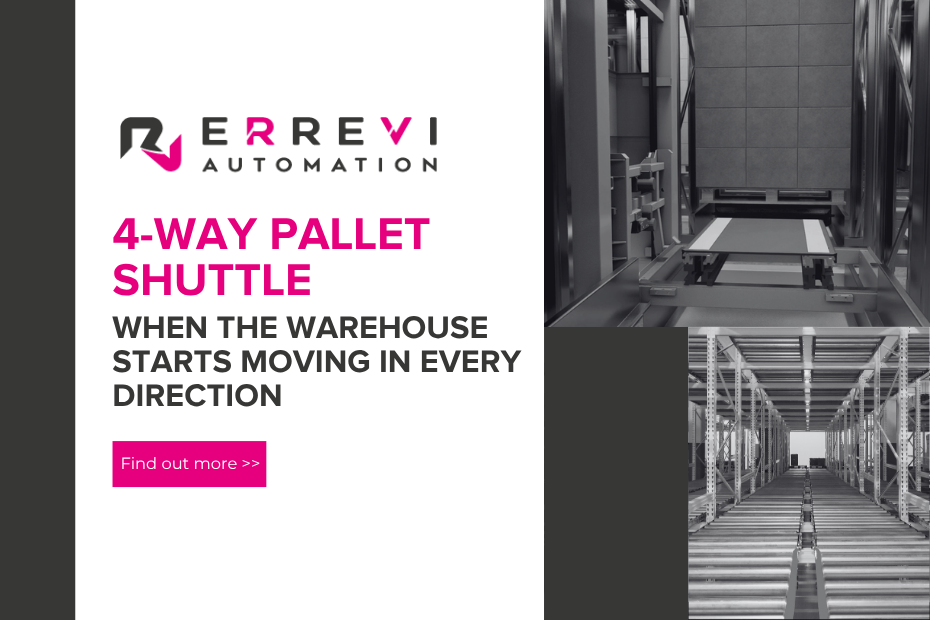
The 4-Way Pallet Shuttle, or 4-Way Pallet Shuttle, is an automated system for the storage of goods and the handling of pallets, in which the shuttle can move both lengthways and crossways within the structure, thereby increasing flexibility in the management of space and material flows.
For a long time, talking about warehouse automation meant envisaging systems capable of moving along clearly defined routes: forwards, backwards, from one point to another.
But what happens when the system can move in four directions?
A new approach to automated storage is emerging: more dynamic, more flexible and capable of making intelligent use of the available space.
This is the principle behind the 4-Way Pallet Shuttle, an automation technology for pallet storage that combines high-density storage, automated handling and freedom of movement within the facility.
It is not simply a shuttle that moves along a lane. It is the warehouse itself that becomes dynamic.
The 4-Way Pallet Shuttle is an automated storage system in which a motorised shuttle can move both lengthways and crossways within the structure.
Unlike traditional shuttles, which mainly operate in a single direction, 4-Way technology allows the vehicle to change direction and move from one lane to another.
This feature significantly expands the possibilities for warehouse management.
The system can, in fact:
The result is greater flexibility in system design and flow management.
The main difference lies in freedom of movement. In a traditional shuttle system, each vehicle generally operates within a specific lane. The logic is therefore closely linked to the geometry of the racking.
With a 4-way shuttle, on the other hand, the system can move along two axes. Let’s imagine a grid. The shuttle can travel along it in one direction, change axes and continue its path.
This means that the warehouse can no longer be designed simply as a series of aisles, but as a dynamic handling network. And it is precisely here that the concept of automation takes on a new dimension.
One of the main advantages of 4-way Pallet Shuttle systems is the ability to create high-density storage solutions. When available space is limited, simply increasing the floor area of the warehouse is not always possible. Utilising vertical space allows storage capacity to be increased whilst keeping the floor space required to a minimum.
In this scenario, the storage facility becomes an integral part of the automated system, and the shuttle handles the movement of pallets between the various levels.
High density, however, does not have to mean rigidity. This is one of the most interesting aspects of 4-Way technology.
An automated storage system must be capable of adapting to the company’s operational requirements: fluctuations in volume, the number of SKUs, the frequency of picks and different stock management methods. The ability to move the shuttle in multiple directions makes it possible to design systems with greater flexibility than configurations characterised by exclusively linear routes.
This makes it easier for the warehouse to become more scalable and adaptable to changes in the business.
So what is the difference?
The key distinction concerns the ability to change direction.
| Traditional shuttle | Pallet Shuttle 4 Way | |
| Movement | Mainly along the lane | Longitudinal and transverse |
| Flexibility | Restricted to a single lane | Greater freedom of movement |
| Lane management | Vehicle associated with the lane | Option to move between lanes |
| Density | High | High |
| Layout | More dependent on the layout of the lanes | Greater design freedom |
| Automation | Alta | Alta |
This does not mean that the 4-Way is always the best solution. The choice depends on the company’s logistics profile, the characteristics of the pallets, and the volumes and frequency of operations.
And that is precisely why design comes before technology.
The real challenge? Coordinating all the movements. When a system can move in four directions, flow management becomes even more important.
It is not enough to know where a pallet is. The system must know where it needs to go, when it needs to get there, and which route is the most efficient. This is where the software comes in.
A modern AS/RS system must coordinate storage and picking operations, manage priorities, optimise movements and interface with the company’s information systems.
The result is an ecosystem in which hardware and software work together.
The shuttle represents movement. The software represents the intelligence that decides how to organise it.
Find out more about the solution
Find out about the features and configurations of Errevi Automation’s Pallet Shuttle solution for automating the storage and handling of pallets.
Discover the Pallet Shuttle solutionThe concept of AS/RS – Automated Storage and Retrieval System – is precisely in line with this approach.
An automated storage and retrieval system does more than simply store pallets. It manages their intake, location, retrieval and transfer to the next stages of the logistics process.
When integrated with a WMS, WCS or WES, the system can become part of a wider ecosystem in which information drives the physical movement of goods.
It is here that warehouse automation moves beyond simply replacing manual labour to truly optimising workflows.
There is no one-size-fits-all answer for every warehouse. Technology can be particularly useful when a company needs to manage:
But before choosing the technology, it is necessary to analyse the process.
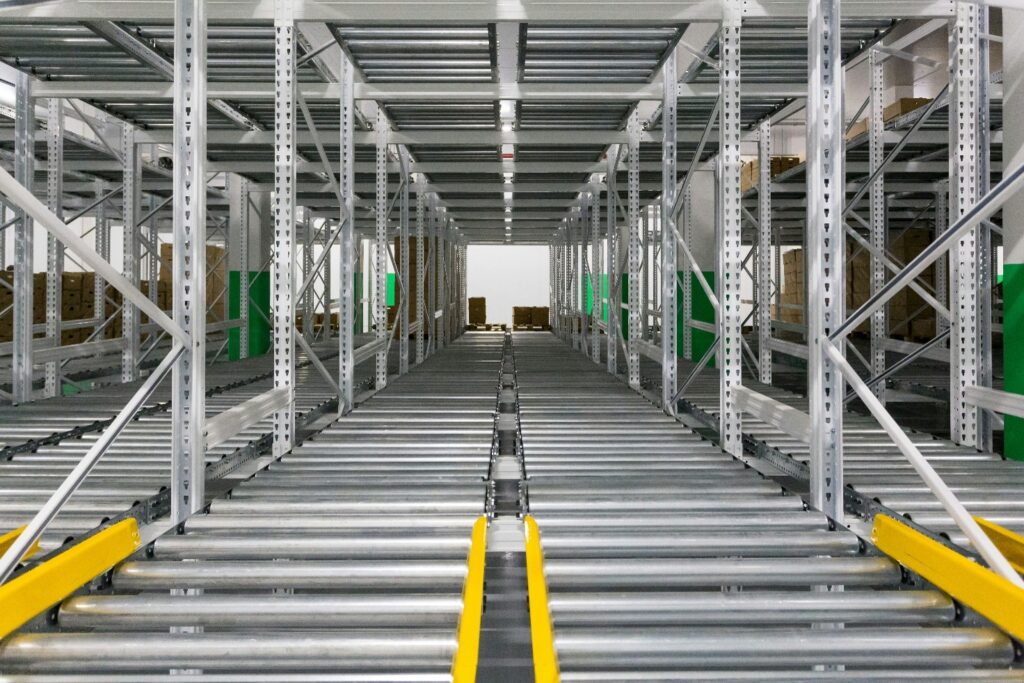
When we talk about warehouse automation, we often think of the ability to make the most of vertical space. But the real change runs much deeper. The warehouse of the future will be vertical, dynamic and connected.
Automated storage systems will become increasingly integrated with software, material-handling systems, robots and smart technologies.
The 4-Way Pallet Shuttle perfectly embodies this evolution: a technology that combines high storage density with freedom of movement.
Because whilst a warehouse used to be simply a space to be filled, today it can become a system to be managed.
For Errevi Automation, automating a warehouse means, first and foremost, understanding its material flows. The decision to opt for 4-way Pallet Shuttle technology must form part of a broader design strategy that takes into account the structure, material handling, software, performance and potential for future development.
The aim is not simply to increase the number of pallets in storage. It is to create a system in which every movement follows a logical pattern and every space is used intelligently.
Is your warehouse ready to move in all directions?
Find out how a Pallet Shuttle 4-Way automated storage solution can help you increase the capacity, density and flexibility of your warehouse.
Contact Errevi Automation to discuss your project and find the solution best suited to your material flows.
Warehouse automation
Find out how a 4-Way Pallet Shuttle solution can help increase your warehouse’s capacity, density and flexibility, whilst integrating seamlessly into an automation project tailored to your logistics flows.
The 4-Way Pallet Shuttle is an automated storage system in which a motorised shuttle can move both lengthways and crossways within the structure, travelling between different aisles.
How does a 4-way pallet shuttle work?
The shuttle moves pallets around the facility, travels to different storage locations and handles storage and retrieval operations. The software coordinates tasks, priorities and routes.
The main difference concerns freedom of movement. A traditional shuttle operates mainly along a single aisle, whilst a 4-Way system can move both lengthways and crossways and transfer between aisles.
It may be of particular interest to warehouses that handle large quantities of pallets, have limited floor space or require greater storage capacity, flexibility and automation of material handling.
The 4-Way Pallet Shuttle can operate within an automated storage and retrieval system in which software and handling systems coordinate the storage, management and retrieval of pallets.