Contatti:
+39 0536 284111
Indirizzo:
Via Giovanna Maria Dallari, 2 - 41049 Sassuolo (MO) Italy

Contatti:
+39 0536 284111
Indirizzo:
Via Giovanna Maria Dallari, 2 - 41049 Sassuolo (MO) Italy

Warehouse logistics automation is not limited to the introduction of robots or the automation of individual tasks. In an environment characterised by increasing operational complexity, the real aim is to design a system capable of optimising workflows, increasing production capacity and generating measurable economic benefits over time.
Rising volumes, an increase in the number of SKUs, the fragmentation of orders, shorter delivery windows and difficulties in recruiting staff are profoundly changing the requirements for warehouse design and management.
In this scenario, focusing on a single process may lead to localised improvements, but does not always enable the overall performance of the operation to be optimised.
When warehouse storage, goods handling, order picking, replenishment and dispatch are closely interlinked, it is necessary to adopt a systematic approach.
This is where the concept of integrated warehouse automation comes into play: an architecture in which hardware technologies, software systems and operational processes are designed and coordinated as a single ecosystem
Warehouse logistics automation involves the coordination of technologies, software and processes to manage storage, handling, picking and operational flows more efficiently. The individual technologies do not operate as isolated elements, but are designed within a common architecture.
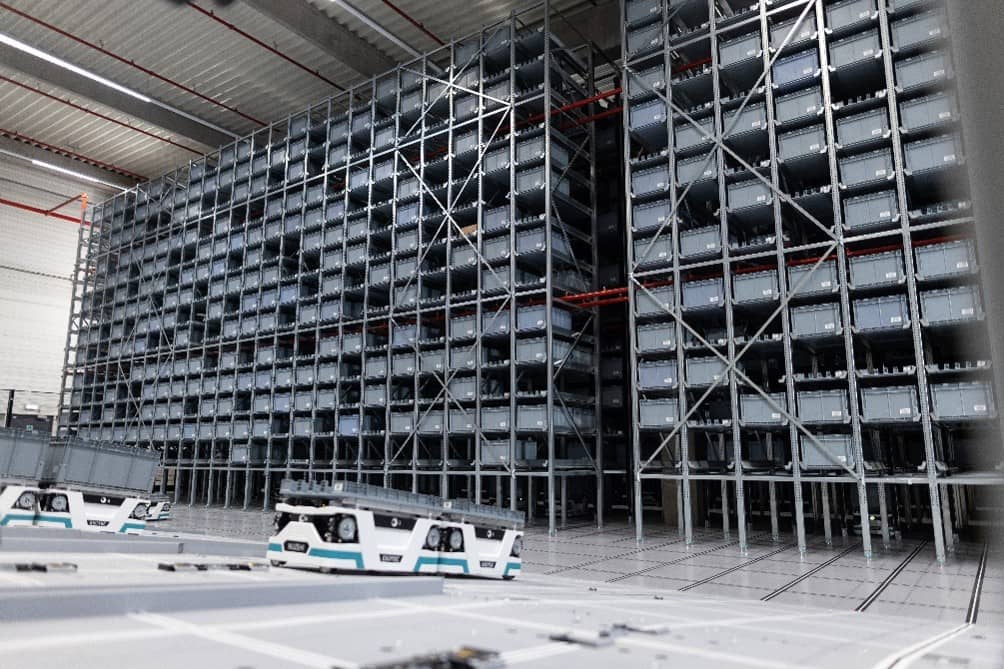
Exotec’s Skypod technology is designed according to a ‘goods-to-person’ model, in which the load units move to the operators rather than the other way round.
Mobile robots operate within three-dimensional storage facilities, moving containers between different areas of the system and automatically supplying the workstations with the required items.
This approach makes it possible to address, simultaneously, some of the key performance drivers in a warehouse: storage density, picking productivity, a reduction in manual movement, and the ability to adapt to changes in flow.
Making use of vertical space allows storage capacity to be increased whilst maintaining the same floor area, whilst the ‘Goods-to-Person’ approach reduces the distances travelled by operators, allowing manual tasks to be focused on operations with higher added value.
The system can also be incorporated into a broader intralogistics framework, integrating with conveyors, sorting systems, picking technologies, packing areas and software platforms for managing and coordinating flows.
The aim is not simply to maximise the performance of a single technology, but to optimise the operation of the entire system.
The ROI of automation: an assessment based on operational performance
The economic assessment of a warehouse automation project is often associated primarily with a reduction in labour requirements.
Si tratta di una componente importante, ma non sufficiente per misurare il valore generato da un investimento.
An automated system can have an impact on several performance indicators at the same time:
Increasing throughput without proportionally increasing the resources used enables organisations to manage volume growth with a more efficient operational structure.
Increasing storage density can make better use of the available floor space and, in some cases, avoid or postpone investment in expanding the facility.
Reducing manual handling, on the other hand, involves addressing both productivity and the organisation of work, by redeploying staff to tasks that require greater expertise or decision-making skills.
ROI must therefore be assessed by taking into account the total cost of the project and the economic value generated by the improvement in operational performance over time.
So it’s not just about cost reduction, but also about increased capacity, productivity, service quality, flexibility and resilience.
Integration of workflows: reducing operational complexity
Modern warehouses have to manage an increasing number of variables: seasonality, peaks in demand, changes in the order mix, a growing number of product lines and increasingly stringent service requirements.
For automation to be truly effective, it must not create new technological silos.
Each component must be integrated into a coordinated process, in which information and physical movements proceed in a synchronised manner.
In the case of a Skypod system, for example, the retrieval of storage units must be coordinated with the mission allocation logic, the supply of picking stations, replenishment activities and, where applicable, with downstream systems dedicated to packing, sorting or dispatch.
Performance does not, therefore, depend solely on the speed of the individual robots.
It depends on the entire system’s ability to manage priorities, balance workloads, avoid bottlenecks and maintain continuity in the operational flow.
It is precisely the integration of technologies and software that transforms a set of automated components into a coordinated intralogistics system.
Software and orchestration: the link between processes and automation
In an integrated automation project, warehouse software plays a central role.
ERP, WMS, WES, WCS and automation systems must be able to exchange information reliably and consistently, so that physical movements are always aligned with operational requirements.
The availability of real-time data enables you to monitor the system’s status, manage priorities, identify anomalies and analyse performance using specific KPIs.
Mission planning enables the coordination of the various available resources in line with demand, order priorities and the actual capacity of individual operational areas.
This means moving from a management approach based on independent processes to an integrated end-to-end flow control system.
The aim is to reduce waiting times between one stage and the next, improve the allocation of resources and make the system more predictable and manageable.

Any investment in automation must be assessed by taking into account not only the current operational situation, but also how it is likely to evolve.
Volumes may increase, the number of SKUs may grow, the order mix may change, and service requirements may call for new operational configurations.
This is why scalability is a fundamental design requirement.
A system must be able to gradually increase its capacity without requiring a complete redesign of the infrastructure every time demand changes.
The modular approach allows you to plan your investment in line with growth scenarios, gradually adapting resources and capacity to the actual needs of the operation.
Automation thus becomes a platform capable of evolving alongside the business.
Not a facility designed solely to address current challenges, but an infrastructure capable of supporting new operational requirements over time.
In a complex intralogistics project, the choice of technology is just one stage of the process.
The outcome depends on the ability to analyse workflows correctly, allocate resources appropriately, identify operational constraints and design an architecture that is consistent with the performance objectives.
This is the role of the system integrator.
A system integrator does not merely install technology; they design the interaction between processes, automation and software.
The analysis begins with the data and operational requirements: order profile, number of SKUs, stock turnover, daily and seasonal volumes, fulfilment times, available layout, loading units and growth prospects.
On this basis, the system architecture is defined and the various components are sized in accordance with the required objectives.
At Errevi Automation, every project is approached by first analysing the logistics process and the specific requirements of the operation.
Skypod and other automation technologies are therefore assessed and integrated into an overall design, in which each component must contribute to the achievement of specific, measurable objectives.
Because high-performance technology, on its own, does not automatically guarantee system performance.
Value stems from the ability to design an architecture in which every technology can operate in a coordinated manner and realise its full potential.
An effective automation project does not begin with the choice of a robot. It begins with a process analysis.
Where are the bottlenecks concentrated? Which activities result in the most downtime? What is the actual level of resource utilisation? How is the available space being used? What are the growth forecasts for volumes and product lines?
These are the questions that enable us to define a coherent automation strategy.
Technology must be the answer to an operational need, not the starting point for the project.
Skypod can be a strategic component of a Goods-to-Person system, but its value increases when it is integrated into an ecosystem designed to coordinate physical flows, information and operational resources.
The future of intralogistics is not simply about automation. It is integrated, scalable and measurable in terms of performance. Would you like to assess the potential for automation in your warehouse?
Every project has its own specific variables: volumes, number of SKUs, order profiles, available space, operational flows and growth targets.
That is why there is no single ‘best’ technology, but rather the solution best suited to the characteristics of each individual process.
Let’s talk about your warehouse.
We analyse workflows, identify the key areas for improvement and assess which automation technologies and architectures can deliver a measurable increase in operational performance and a sustainable return on investment over time.
Logistics automation
We analyse flows, volumes, space and operational objectives to identify automation technologies and architectures that meet the needs of your warehouse.
Let’s talk about your projectWarehouse logistics automation integrates hardware technologies, software systems and operational processes within a coordinated architecture, with the aim of optimising workflows and overall performance.
Skypod can be incorporated into a broader intralogistics framework and integrated with conveyors, sorting systems, picking technologies, packing areas and software platforms for the management and orchestration of flows.
ERP, WMS, WES, WCS and automation systems enable the exchange of the information required to coordinate movements, priorities, orders and operational resources.
ROI must be assessed by taking into account the total cost of the project and the economic value generated over time by the improvement in operational performance. The indicators discussed in the article include throughput, productivity, storage density, accuracy, lead time, scalability and the ability to absorb peaks in demand.
Scalability allows capacity and resources to be progressively adapted to changes in volumes, SKUs, order mix and operational requirements.