Contatti:
+39 0536 284111
Indirizzo:
Via Giovanna Maria Dallari, 2 - 41049 Sassuolo (MO) Italy

Contatti:
+39 0536 284111
Indirizzo:
Via Giovanna Maria Dallari, 2 - 41049 Sassuolo (MO) Italy

Automated pallet handling is a strategic component of intralogistics automation. In warehouses and production facilities, automated pallet handling links goods receipt, storage, production, order picking, quality control and dispatch, coordinating the movement of load units between the various operational areas.
When these transfers are handled mainly using forklift trucks and manual labour, the increase in volumes can make it more difficult to manage the flow of goods, leading to queues, inefficient routes and greater reliance on the availability of operators.
Automated material-handling systems, on the other hand, enable the creation of seamless links between the various operational areas, transforming pallet transport into an integrated, controlled and coordinated process.
Automatic pallet handling refers to the combination of hardware and software technologies used to automatically transport, transfer, store and route load units within a warehouse or production facility.
In practice, an automated pallet handling system receives the load units, manages their movement along defined or dynamic routes, and directs them to their intended destination. The handling can be carried out using roller conveyors, chain conveyors, lifts, AGVs and AMRs, all coordinated by the plant’s control systems.
An automated handling system must be integrated into the overall intralogistics workflow, linking different processes and areas.
To link these activities, automated handling and material-handling solutions enable the integration of systems for the transport and transfer of load units within the logistics flow.
For example, it can handle the transfer of:
The result is an automated flow of goods in which each load unit can be identified, handled and directed to its intended destination.
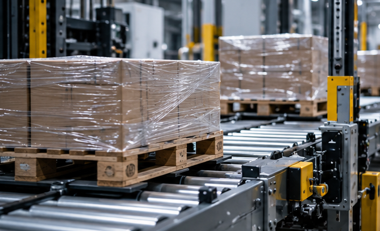
Materials handling is one of the most widespread activities in intralogistics: virtually every process involves at least one movement of goods. Automating the most repetitive stages enables, first and foremost, greater continuity of flows.
Loading units can be transferred between different areas, reducing reliance on manual handling and making process times more predictable. An automated system also enables movements to be coordinated according to actual operational requirements, managing destinations, sequences and priorities.
Reducing forklift traffic along the most repetitive routes can also contribute to better organisation of space and more effective management of the interaction between vehicles, goods and people.
Automating material handling therefore means focusing not only on the speed of transport, but also on the overall efficiency of internal handling.
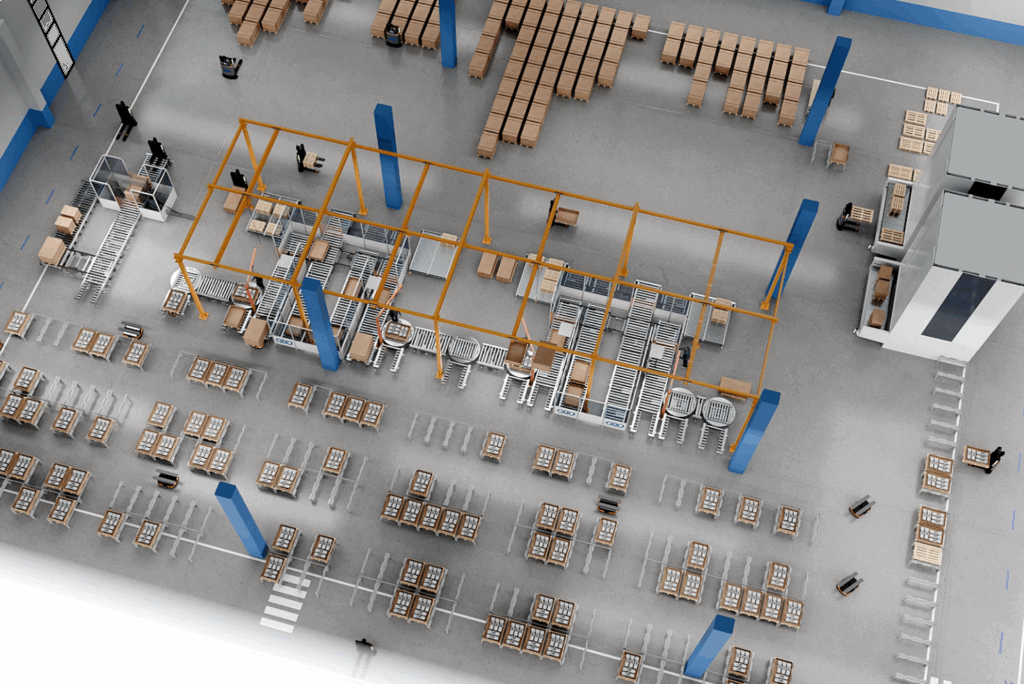
There is no single technology for automating the handling of pallets. The solution depends on the type of flow, the distances involved, the volumes to be handled, the warehouse layout and the level of flexibility required. Furthermore, in many projects, the best results are achieved by combining several handling technologies.
Pallet conveyor systems enable load units to be transferred or accumulated along defined routes. They are particularly suitable for linking areas characterised by frequent and repetitive flows, such as production lines, palletising systems, storage areas, picking areas and dispatch areas. They can also create intermediate buffers between processes operating at different speeds, helping to ensure a more continuous flow.
Pallet chain conveyors are another solution for the automatic handling of load units.
Together with transfer units, rotary tables and direction-changing devices, they enable the creation of more complex routes, automatically distributing pallets to different destinations. The configuration must be determined on the basis of the characteristics of the load units, their weight, the direction of movement and the required throughput.
Automated handling does not necessarily have to take place on a single level. Pallet lifts make it possible to connect different areas of the factory or different levels of a logistics system, thereby allowing for better utilisation of vertical space. They can be integrated with roller conveyors and other transport systems to ensure a continuous flow.
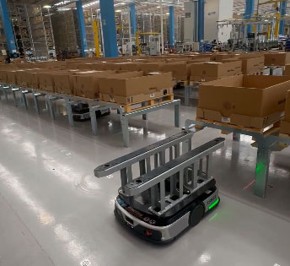
Where the process requires greater flexibility, the transport of load units can also be carried out by AGVs and AMRs.
The technologies available include automated guided vehicles (AGVs) and autonomous mobile robots (AMRs), which should be assessed on the basis of the route characteristics, the load units and operational requirements.
These systems enable pallets to be moved between different areas without necessarily requiring a fixed transport infrastructure along the entire route.
They can therefore be particularly useful when there are numerous origins and destinations, when the layout needs to remain flexible, or when it is necessary to integrate distant areas of the plant.
The true potential of automation becomes apparent when the handling system is not designed as an isolated component. Handling can become the physical link between production, storage, order fulfilment and dispatch.
A pallet coming from the end of the production line, for example, can be identified and automatically transferred to a build-up area or a storage system.
The link with the warehouse storage systems enables the transfer, storage and subsequent retrieval of load units to be planned in a coordinated manner. Where necessary, the same load unit can be retrieved and directed to a workstation, a picking area or directly to dispatch.
In this scenario, handling and storage are no longer two separate processes, but parts of the same automated intralogistics flow.
Behind the physical movement of goods lies a second, fundamental level: the digital one. In a complex system, it is not enough simply to know that a pallet needs to be moved. It is necessary to know which load unit to move, to which destination, with what priority, and using which resource.
The WCS – Warehouse Control System enables the coordination of various automation technologies and the orchestration of tasks within the facility. When roller conveyors, belt conveyors, lifts, AGVs, AMRs and other systems form part of the same process, the software therefore becomes a key element in synchronising the flow.
Automated handling thus becomes a process in which hardware, software and information work in a coordinated manner.
The design process should start with the process and material flows, not with a specific technology.
Before deciding whether to use roller conveyors, belt conveyors, AGVs, AMRs, lifts or a combination of several systems, it is necessary to analyse a number of key factors.
Only after this analysis can we determine which technologies to use and, above all, how to integrate them into a single handling system.
Automating pallet handling does not, therefore, simply mean installing a roller conveyor, a conveyor belt, an AGV or an AMR. It means designing an integrated material-handling system capable of linking the various stages of intralogistics.
This is where the role of the system integrator takes on particular importance. Errevi Automation designs and integrates automated handling and material-handling solutions, starting with an analysis of material flows, load units and production and logistics objectives.
Transport systems, material-handling technologies, mobile robotics and software can thus become components of a single architecture designed around the specific needs of the warehouse. The aim is not to automate every movement, but to identify where and how automation can make the flow more efficient, continuous and scalable.
The main technologies include pallet roller conveyors, chain conveyors, lifts, transfer systems, AGVs and AMRs. The choice depends on volumes, routes, the characteristics of the load units and the level of flexibility required.
Automation can be particularly useful when transfers between production, storage and dispatch are frequent and repetitive. The cost-effectiveness must be assessed by considering throughput, layout, operating costs, safety and potential for growth.
Automated pallet handling manages the movement of load units between different operational areas. Automated storage, on the other hand, involves the storage and retrieval of goods. The two processes can be integrated to create a continuous intralogistics flow.
Would you like to automate pallet handling in your warehouse?
Every automated handling project begins with an analysis of material flows, load units and operational requirements. Errevi Automation designs and integrates handling and material-flow systems, as well as software, to link production, storage and dispatch into a single, coordinated process.
Contatta il team Errevi Automation per valutare le soluzioni più adatte al tuo progetto.